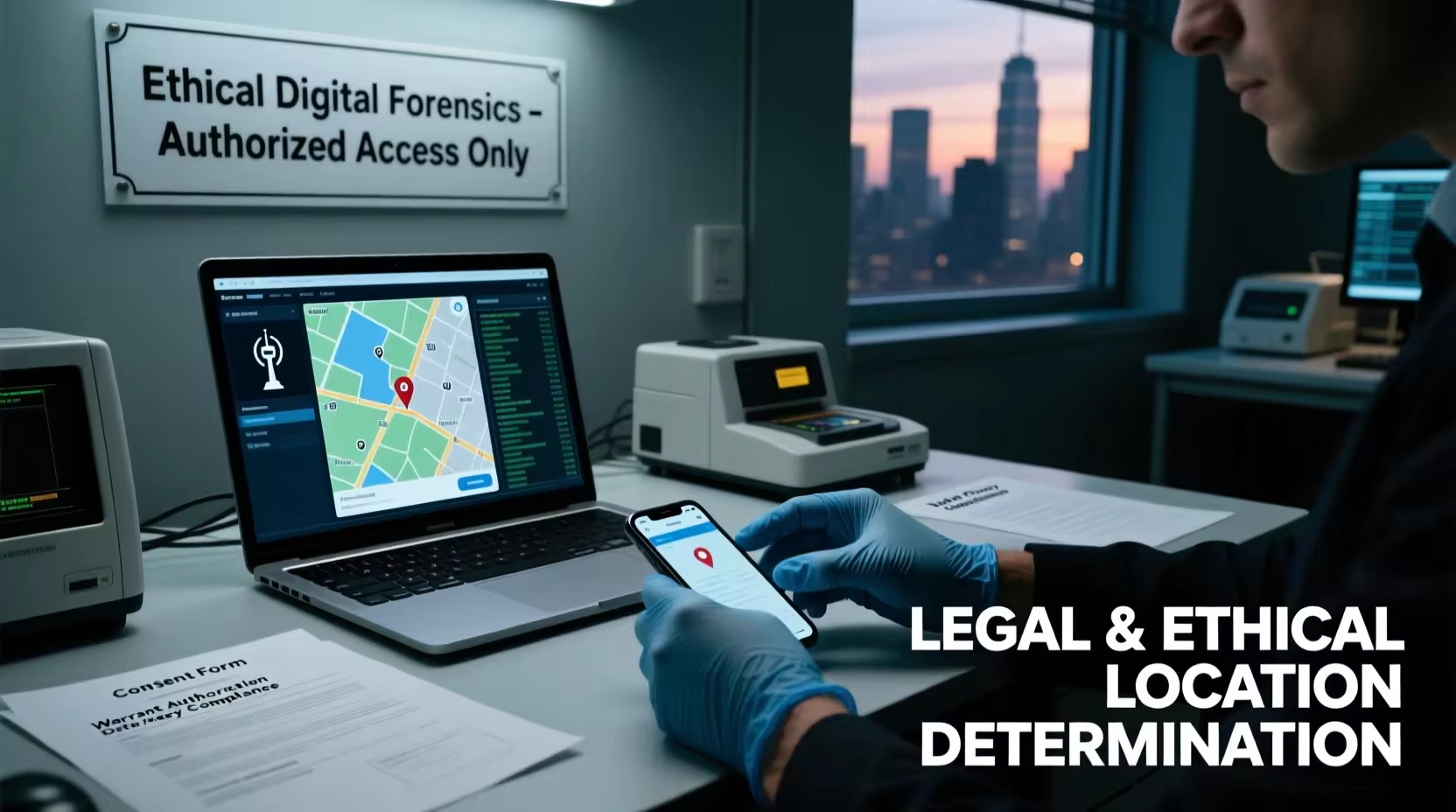
Trust is the bedrock of any healthy relationship, yet in the digital age, the lines between privacy and transparency are often blurred. There are many legitimate reasons why someone might want to know where their significant other is, ranging from safety concerns during solo travel to coordinating busy daily schedules. However, navigating the digital world requires a balance between the need for information and the respect for individual privacy. If you are wondering how to find your partner’s location legally and ethically, the answer lies in open communication, mutual consent, and the use of technology that respects the boundaries of both individuals.
In 2026, the concept of “location sharing” has become a social norm for many couples. With the rise of safety features on smartphones and the increasing complexity of urban life, knowing a partner is safe can provide immense peace of mind. This guide explores the most effective, lawful, and morally sound methods to stay connected without compromising the integrity of your relationship.
The Legal and Ethical Framework of Location Tracking
Before looking at technical tools, it is crucial to understand the legalities. In almost every jurisdiction, tracking an adult’s physical location without their knowledge or consent is considered a violation of privacy laws and, in some cases, can be classified as stalking or harassment. Legality is binary: you either have permission, or you are breaking the law.
Ethically, the situation is more nuanced. Tracking should never be used as a tool for control or to feed an obsession. Instead, it should be viewed as a “safety net.” For instance, if your partner frequently commutes late at night or travels to unfamiliar cities for work, location sharing becomes an act of care rather than a breach of privacy. The ethical approach involves a conversation where both parties agree on why the tracking is happening, who has access to the data, and under what circumstances it should be checked.
Mutual Consent: The Foundation of Ethical Tracking
The most effective way to stay informed is through “Consensual Visibility.” This involves sitting down with your partner and discussing your concerns or needs. You might say, “I worry when you’re driving home late from work; would you be open to sharing your location so I know you’ve arrived safely?”
When a partner agrees to share their location, it removes the secrecy and the potential for conflict. It transforms a “spy” activity into a collaborative safety measure. Most modern smartphones have built-in features designed specifically for this type of consensual sharing, making it easier than ever to stay connected legally.
3 Legal and Ethical Ways to Find Your Partner’s Location
1. Built-in OS Features (Apple & Google)
The most common and ethically sound methods are the native “Find My” (iOS) and “Google Maps Location Sharing” (Android) features. These tools are built for transparency; they require the user to actively enable sharing and often send periodic reminders to the user that their location is being shared with someone else.
- The Benefit: It is free, accurate, and completely legal because it is based on the user’s explicit permission.
- The Ethical Check: Since the target phone shows a notification or an icon, there is zero deception involved.
2. Family Safety Apps
Apps like Life360 are designed for families and couples. They create “Circles” where everyone in the group can see each other on a map. These apps often include “Place Alerts,” which notify you when a partner arrives at work or home, reducing the need to constantly check the phone.
- The Benefit: It automates the “I’m safe” text message.
- The Ethical Check: It is a group decision. Everyone in the Circle knows they are being tracked, which fosters a culture of mutual safety.
3. Professional Monitoring for Specialized Situations
In some specific cases—such as protecting a partner with medical conditions (like early-onset dementia or severe allergies) or ensuring safety in high-risk professions—professional-grade software is used. For those who need a more robust and permanent safety solution, searching for how to find your partner’s location legally and ethically often leads to high-end monitoring services.
Professional tools like Spymaster Pro offer a level of detail that standard apps might miss, such as a historical log of locations visited. When used with consent, these tools provide a secure, encrypted dashboard where you can monitor movements. This is particularly useful for long-term safety planning where a simple “ping” on a map isn’t enough.
The Risks of Non-Consensual Tracking
Attempting to track a partner through “stealth” means without a legal basis (such as a safety agreement) is fraught with danger.
- Legal Repercussions: You could face criminal charges or civil lawsuits for invasion of privacy.
- Relationship Destruction: If your partner discovers a hidden tracker or app, the trust in the relationship may be permanently destroyed, regardless of your intentions.
- Security Risks: Many “free” or “shady” tracking websites are actually scams that will steal your personal data or credit card information. Always stick to reputable, professional services.
When Location Tracking Becomes Necessary for Safety
There are moments when the need for information outweighs the standard rules of privacy, such as when a partner goes missing or is in immediate danger. In these emergencies:
- Emergency Services: If you believe your partner is in danger, contact the police. They have the legal authority to ping cell towers to find a location.
- Emergency SOS Features: Most phones have a feature where a user can press a button five times to send their location to their “Emergency Contacts.” Encourage your partner to set this up.
Best Practices for a Healthy Tracking Policy
To ensure your use of location technology remains ethical, follow these guidelines:
- The “Two-Way Street” Rule: If you want to see their location, you should be willing to share yours. This creates a balance of power and proves that the intent is safety, not control.
- Define the Boundaries: Agree on when it is okay to look. For example, “I will only check your location if you are more than an hour late and haven’t answered your phone.”
- Respect the “Off” Switch: If your partner wants to turn off location sharing for a day to have some personal space, respect that choice without becoming suspicious.
The Future of Location Intelligence in 2026
As we move through 2026, GPS technology has become more precise than ever, using “Dual-Band GPS” to find a phone’s location within a few centimeters. We are also seeing the integration of AI that can predict if a partner has been in an accident by analyzing sudden stops in movement combined with airbag deployment sensors. These advancements make location sharing a vital part of the “Smart Family” ecosystem, where the goal is collective well-being rather than individual surveillance.
Choosing the Right Tools
If you decide to move forward with a professional service for long-term safety and location logging, ensure you choose a provider that emphasizes data encryption. Your partner’s location data is sensitive; you don’t want it stored on a server that can be easily hacked. Professional services provide a secure, password-protected environment, ensuring that the information stays between you and your partner.
Conclusion
Finding a partner’s location is a powerful capability that must be handled with the highest level of integrity and respect for the law. By prioritizing mutual consent and using professional, transparent tools, you can transform location tracking from a source of suspicion into a valuable safety feature that strengthens the bond of trust in your relationship.