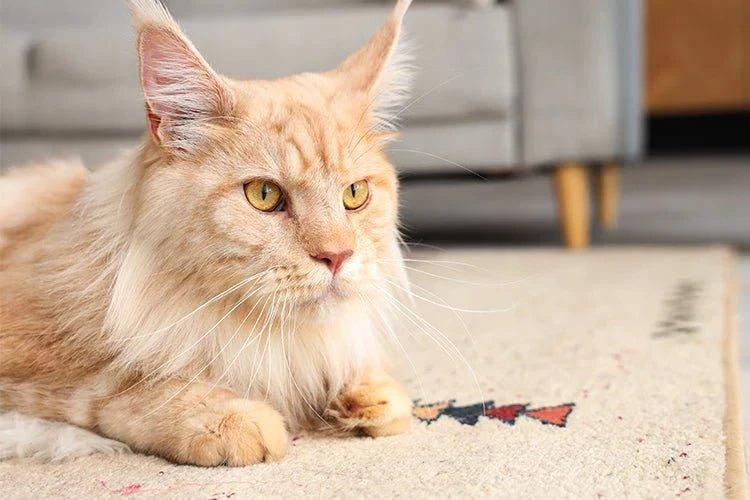
Owners of Maine Coons tend to discover the same frustration in the same way. They buy a covered box because it looks tidy, the cat uses it reluctantly, and within a week there are accidents on the tile beside it. Or they buy an open pan, watch litter fly across the laundry room, and wonder whether a hood would have been the smarter choice.
Neither design is inherently correct. The right answer depends on how your cat moves, how warm your home runs, and how many cats share the box. This comparison looks at what open and enclosed designs offer a large, long-bodied cat, where each one tends to fail, and how to settle the question with a short trial rather than guesswork.
What Enclosed Boxes Offer a Large Cat
Hoods and domed lids exist mainly for the owner’s benefit, and for some cats they work beautifully. Enclosure traps odor, keeps urine spray off nearby walls, and gives a shy cat a sense of privacy. For a Maine Coon that likes to tuck itself away, the enclosed version of a maine coon litter box can be the preferred spot in the house, provided the interior is genuinely spacious.
Enclosure also gives an anxious cat a retreat. In a busy household with children, dogs, or frequent visitors, a hooded box lets a Maine Coon do its business without feeling watched, and that privacy often translates into fewer accidents. The catch is that the privacy must not tip into confinement; a box where the cat cannot turn around freely is worse than a box with no hood at all.
The catch is that stock covered boxes are sized for ordinary cats. A Maine Coon inside a small dome is effectively wearing a hat while using the bathroom, and most will express their opinion by crouching awkwardly near the door or stepping in their own waste. Enclosure only works when the box is scaled up along with the cat.
Ventilation and Heat
Cleanliness inside a hooded box also degrades faster than owners expect. Without airflow, moisture and odor linger on the interior walls, and a Maine Coon may begin sniffing the entrance and turning away. A hood that lifts off for washing makes that maintenance realistic, while a sealed top that must be maneuvered out of a tight corner tends to go unwashed for weeks.
Large cats generate more body heat, and a closed plastic shell holds it in. In a warm room, a hooded box becomes stuffy enough that cats avoid lingering, rushing the visit and creating accidents outside. Vent slots help, but many hoods only vent through a single small opening or a flap that stays shut. If your home runs warm in summer, an enclosed box needs either generous ventilation or an airier alternative.
Where Open Pans Fail and How to Improve Them
For an older Maine Coon, the open pan often wins outright. Senior cats with stiff joints do not want to lift a heavy body over a wall or squeeze through a flap, and a low-entry pan lets them walk in and out without effort. The mess is a fair trade for a cat that keeps using the box comfortably into its later years.
Open pans win on air, visibility, and ease of cleaning. A Maine Coon can enter from any side, turn without scraping its shoulders, and watch the room while it goes, which many cats prefer. The obvious drawback is mess: with a long body and large paws, litter gets kicked over the low rim and tracked across the floor.
Volume is the other drawback. An open pan offers no barrier to odor, and a Maine Coon produces more waste than an average cat, so the room can smell noticeably between cleanings. Frequent scooping becomes mandatory rather than optional, and in a small apartment the difference between an open and a covered box is obvious within a day. Owners who choose open designs usually accept that trade-off in exchange for a cat that never feels enclosed.
Most of that mess is fixable. A pan with higher sides but a lowered front entry contains spray without forcing a climb. A textured mat at the exit catches granules from the paws, and a slightly deeper fill of larger-grain litter reduces the flinging that happens during digging. None of these adjustments change the fact that the box is open, and for a cat that dislikes confinement, that is the entire point.
Placement Changes the Calculation
Placement is often what decides the entire debate, so it is worth considering before buying either design. An open box in a quiet corner with a mat can be a cleaner solution than a hooded box jammed into a busy hall, simply because the cat uses the first one reliably. The same open pan placed in a hallway, by contrast, will scatter litter into every room the cat walks through afterward. Before rejecting an open design over mess, try moving it first; location often determines whether a design feels workable, and a quiet corner can make a simple pan the most practical option in the house.
The Middle Ground: Large Enclosed or Semi-Covered Units
The best compromise for many Maine Coons is a unit large enough that enclosure does not mean crowding. Oversized covered boxes with high ceilings, wide doors, and a removable hood give the cat room to move while still keeping odor contained. Automatic versions from makers such as Meowant can fit this category when the interior drum is sized for a long body, though owners should confirm usable dimensions rather than external ones before committing.
Removable hoods deserve special attention. A hood that lifts off easily lets you convert the box between open and enclosed as the cat’s preferences, or the season, change. It also makes deep cleaning far simpler, because you can wash the hood separately instead of wrestling a rigid shell in a sink. For a multi-cat home, a convertible box offers flexibility that a fixed design cannot.
Semi-covered designs, with a high back and low front, capture a surprising amount of spray while leaving the entrance open and visible. They are easier for an older Maine Coon to enter than a domed box and simpler to scoop than a fully enclosed one.
A Short Trial Beats Speculation
Cost and cleaning effort belong in the decision too, though neither should override the cat’s comfort. A simple open pan is inexpensive and easy to wash, while a large enclosed or automatic unit costs more up front and demands regular maintenance of moving parts. The savings of a cheap pan vanish if the cat refuses it, and the convenience of an automatic box is wasted if the interior is too cramped for a Maine Coon to use comfortably.
If you are unsure which design your cat prefers, run a controlled experiment. Place an open pan and a covered box side by side, each with fresh litter and the same depth, and track which one gets used over a week. Cats are consistent when given a choice, and their preference usually settles the argument within days. Pay attention to how long each visit lasts; a cat that rushes out of a hooded box is telling you that enclosure feels unsafe.
Whichever design wins, keep the same litter, depth, and cleaning schedule during the trial so the comparison reflects enclosure rather than variables like odor or texture.
If neither box gets used and the cat keeps eliminating elsewhere, the problem is probably not the design at all. Stress, illness, or a litter area that feels unsafe can all push a cat away from a perfectly good box, and switching hoods will not fix any of them. In that case, a veterinary check and a review of the room’s traffic are more useful than another shopping trip.
Let the Cat Decide
For a Maine Coon, the open-versus-enclosed question comes down to space and temperament rather than marketing. A generously sized enclosure suits a cat that likes privacy and a home that needs odor control; an open pan with raised sides suits a cat that values visibility and an owner willing to manage a little scatter. The deciding factor in both cases is whether the box truly fits a long body, because no hood or ramp rescues an undersized pan.
Test both, watch how your cat behaves, and keep the design it chooses. A comfortable cat is far more persuasive than any comparison chart, and the right box is the one your Maine Coon walks into without hesitation.