Trust is not something a platform can claim — it has to be demonstrated, repeatedly, through the quality of the data it publishes. For football fans who rely on aggregated odds to follow matches and understand market movements, the stakes of that reliability are real. Kèo Nhà Cái 95 at keonhacai95.com has been building that track record in the Vietnamese-language market, covering Asian handicap lines, live odds, and multi-bookmaker comparisons for domestic and international competitions alike.
This piece examines what trust actually means in the context of an odds aggregation site — and how the platform earns it in practice.
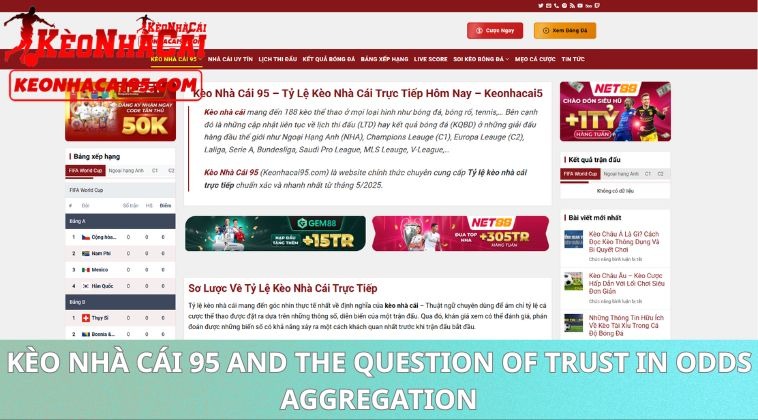
Why Trust Matters More in Odds Aggregation Than in Other Data Sectors
An odds aggregator occupies an unusual position. It does not set the lines itself — it pulls from bookmakers and presents them in a unified format. That sounds straightforward, but the process introduces several points where data integrity can break down.
The Problem with Aggregating from Multiple Sources
When you pull odds from 6 or 7 bookmakers simultaneously, you are dealing with 6 or 7 different data formats, labelling conventions, and update frequencies. A handicap line from one source might express a quarter-ball market as “-0.5/0” while another displays the same line as “-0.25.” Without normalisation logic, a user comparing those 2 figures side by side might think they are looking at different markets when they are actually looking at the same one.
Trustworthy aggregation means the platform has done that translation work invisibly, so what users see is clean, comparable data rather than a raw feed of inconsistent formats.
Latency and Its Effect on Perceived Accuracy
A line that was accurate 4 minutes ago may no longer be accurate now. During the pre-match window — especially in the 60 to 90 minutes before kickoff — bookmakers adjust their lines in response to incoming money, team news, and shifts in public sentiment. An aggregator that refreshes on a slow cycle will display figures that are technically sourced from real bookmakers but reflect a market that has already moved on.
This gap between displayed odds and current market reality is one of the most common ways aggregators lose user trust, often without users being able to identify exactly why the data feels off.
How Kèo Nhà Cái 95 Approaches Data Reliability
Live Feed Architecture
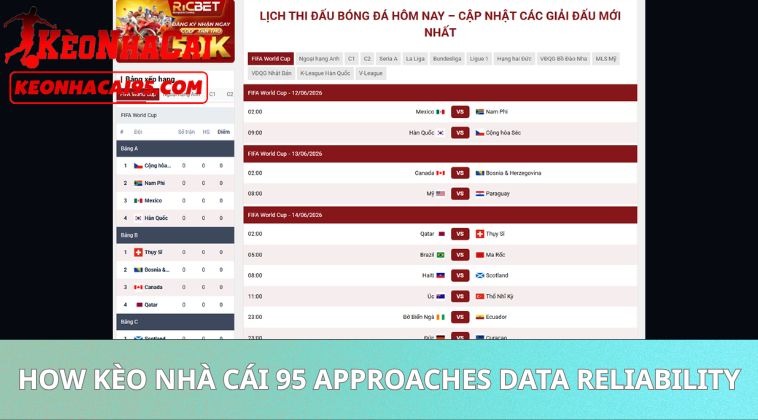
Rather than scraping odds at fixed intervals, Kèo Nhà Cái 95 connects to bookmaker data through live feeds that push updates as they occur. The practical effect is that line movements appear on screen within seconds of the bookmaker making the adjustment — relevant for both pre-match markets and in-play odds during live fixtures.
Cross-Bookmaker Validation
When 1 bookmaker’s line diverges significantly from the consensus across all other sources, the platform flags or verifies the outlier before displaying it. This is not a feature most users ever see directly, but its absence is noticeable — stale or erroneous lines that sit uncorrected for minutes erode confidence in the entire dataset.
Consistent Market Labelling
Every market type — Asian handicap, over/under, European 1X2 — is displayed using consistent labelling conventions regardless of the source bookmaker. Home team is always listed first. Quarter-ball lines are expressed in a standardised format. This consistency makes cross-bookmaker comparison meaningful rather than misleading.
Coverage — The Breadth That Builds Usefulness
A trusted aggregator needs to cover the competitions its users actually care about. For the Vietnamese football audience, that means a mix of regional and international fixtures.
Domestic and Regional Competitions
V.League fixtures are covered alongside competitions from the wider Southeast Asian region — Thai League, J.League, K League, and others. Having regional competitions in the same interface as European leagues removes the need to switch between sources depending on which fixture you are following.
European and Global Competitions
The major European competitions — Champions League, Premier League, La Liga, Bundesliga, Serie A — form the core of the international coverage. For high-profile fixtures, the platform tracks multiple market types simultaneously: Asian handicap, total goals, and 1X2 odds. Seeing those 3 markets in parallel for the same match often reveals nuances that a single-market view would miss.
In-Play Coverage
Live odds shift fast once a match begins. A red card in the 20th minute, a goal against the run of play, or a penalty awarded in stoppage time — each triggers rapid recalibration across bookmakers. In-play coverage on Kèo Nhà Cái 95 reflects these movements as they happen, making the platform useful not just for pre-match research but for following active fixtures in real time.
Odds movement data cited in this article was referenced from https://keonhacai95.com/, where live and pre-match lines are updated continuously across all covered competitions.
Common Reasons Users Stop Trusting an Odds Platform
Understanding what breaks trust helps clarify what maintaining it requires. A few patterns come up repeatedly.
Stale lines displayed as current. When odds that have clearly moved on bookmaker sites still show the old figure on an aggregator, users notice — especially if they cross-check manually. Even 1 or 2 instances of this can create lasting doubt.
Missing fixtures or markets. If a competition you follow regularly disappears from coverage without explanation, or a market type you rely on is absent for a specific fixture, the platform starts to feel unreliable even if its core data is sound.
Inconsistent formatting. Small things — a handicap line displayed one way for some fixtures and differently for others — accumulate into a general sense that the platform is not well maintained.
Frequently Asked Questions
What makes an odds aggregator trustworthy?
Reliability comes from 3 main factors: the speed at which it reflects genuine bookmaker movements, the accuracy of its data validation across sources, and the consistency of how it presents markets to users. All 3 need to be present together.
Does Kèo Nhà Cái 95 cover Asian handicap markets specifically?
Yes. Asian handicap is the primary market format covered, alongside over/under and European 1X2 odds for major fixtures. Line movement history is available for significant matches.
How does the platform handle outlier odds from individual bookmakers?
When a single bookmaker’s line diverges significantly from market consensus, the platform applies cross-source validation before displaying the figure, reducing the risk of erroneous lines appearing unchecked.
Is the data available without registration?
Yes. Odds data on the platform is publicly accessible without requiring an account.
Conclusion
What separates a trusted odds aggregator from an unreliable one is rarely dramatic. It is the accumulation of small things done consistently — lines that update when they should, markets that are labelled the same way every time, coverage that does not disappear unexpectedly. Kèo Nhà Cái 95 has built its standing in the Vietnamese-language market by getting those fundamentals right, match after match and competition after competition. For football fans who need odds data they can actually rely on, that consistency is what makes a platform worth returning to.